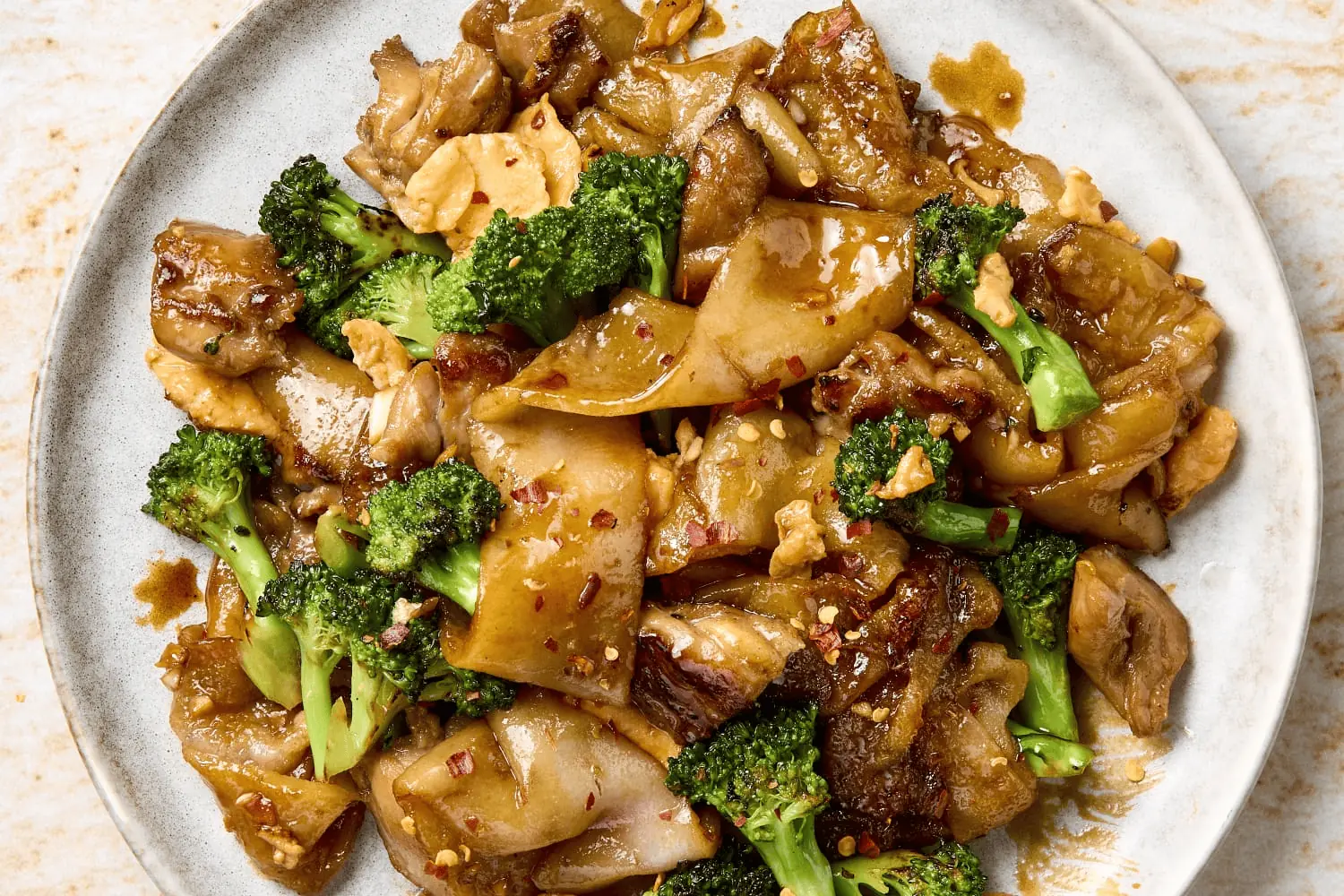
Pad See Ew, Gluten-Free
The same dish, not a lesser one — the noodles were never the problem. The wheat is in the bottles, and one ten-minute caramel syrup solves the only genuinely hard swap.
Noodles
Chicken and Marinade
Premixed Sauce (divided into 4 bowls)
Held Separately, Added Last
Caramelized Dark Soy Syrup (Option C — makes ¾ cup, you need 4 tsp)
The Rest
Prik Nam Som (table condiment)
Overview
This is a sibling of the main recipe, not a different dish. Every technique — the dry preheat, the one-plate rule, the static rest, the black soy last, white pepper at the end — is unchanged, and unchanged for the same reasons. What follows is the shopping and the swaps. Where a step isn’t mentioned here, cook it exactly as written in the main recipe.
Two things are worth saying before you spend money.
The sauce conversion costs much less than people expect. A real gluten-free dark soy loses essentially nothing. Even a from-scratch caramelized syrup loses only aged mellowness and a faint aged bitterness — and this is a dish where high heat and char sit on top of everything.
The noodle conversion may cost more than you expect — not because rice noodles contain wheat, but because a certified gluten-free wide noodle is hard to confirm in normal US retail, and the honest fallback (dried) is the single largest sensory loss in the entire conversion. Larger than any sauce compromise.
“No wheat in the ingredient list” and “certified gluten-free” are not the same claim, and for a celiac the difference is real. US law sets gluten-free at under 20 ppm; GFCO certification audits at 10 ppm or less. An uncertified panel tells you what was deliberately added. It tells you nothing about the mixing line it ran on. Which standard you need is a medical question, not a cooking one — decide it before you shop.
The Gluten Map
| In the main recipe | Why it has wheat | What you buy instead |
|---|---|---|
| Thai thin soy (ซีอิ๊วขาว) | Wheat is a primary fermentation substrate, not a trace — cultured from steamed wheat and soybeans | Healthy Boy GF thin soy (rice-fermented), else San-J or Kikkoman GFCO tamari |
| Thai black soy (ซีอิ๊วดำ) | Built on the same wheat-fermented soy | The hard one — see below |
| Oyster sauce | Wheat arrives twice: as flour thickener and inside the soy sub-ingredient | LKK Panda Green Label, Megachef GF, or Healthy Boy GF |
| Noodles | Not traditional, but some commercial rice noodles do add wheat flour or starch | Read the bag |
| Golden Mountain, if you’d added it | Standard bottle lists wheat gluten outright | The Golden Mountain GF version is real — buy it rather than dropping it |
Already fine, no action needed: the cornstarch or tapioca starch in the marinade, white sugar, distilled white vinegar, the chilies, the gai lan, the eggs, the oil, white pepper, and MSG — which is fermented from starch and contains no protein at all.
Already excluded from this recipe, and staying excluded: Shaoxing wine (the jiǔqū starter is wheat-based) and fish sauce (usually fine, but some formulations carry hydrolyzed wheat protein).
One quiet vector if you go off-script: mushroom and “seasoning” powders are not a single category. Some granulated mushroom bouillons list no wheat; some mushroom sauces lead with wheat flour, and some seasoning powders contain wheat starch. Mushroom soy sauce is dark soy plus mushroom extract — i.e. wheat.
The universal caveat, stated once: formulations change, and export SKUs differ from domestic ones. Everything here is a starting point for reading the bottle in your hand, not a substitute for it.
The One Mistake That Ruins This Dish
Do not buy a GFCO tamari sold under a product title containing the words “dark soy sauce” and think the black soy problem is solved. Multiple grocery retailers list San-J’s certified tamari exactly that way. It is not dark soy sauce. It is tamari: water, soybeans, salt, alcohol. Excellent product, correct choice for your thin soy — but it has no caramel, no added sugar, and no starch, which is all three of the things black soy actually contributes. Buy it believing otherwise and you produce a pale, thin, slick, uncaramelized plate, and then conclude that pad see ew doesn’t work gluten-free. It does.
Adjacent traps, same shape:
- Kikkoman Gluten-Free Soy Sauce is real and GFCO-listed — and is a thin soy replacement, not a dark one.
- Megachef’s GF designation covers their light soy and their oyster sauce. It does not extend to their sweet dark soy. A brand’s gluten-free reputation does not transfer across its product line.
- Anything a retailer names “dark soy sauce” without a matching ingredient list on the bottle itself.
- Coconut aminos as a blanket soy replacement — it gives up salt and fermented depth, adds unwanted sweetness, and forces you to over-pour, which thins the sauce and destroys cling. Soy-allergic only.
Steps
1. Buy the Thin Soy (Your Salt)
Best: Healthy Boy / Dek Som Boon GF thin soy. Their GF bottle is 25% rice where the standard is 25% wheat — otherwise a near-identical ingredient list. They re-ran the actual Thai fermentation on a different substrate rather than dodging to tamari, and it tastes like it. Flavor cost: essentially none.
Fallback: San-J or Kikkoman GFCO-certified tamari. Widely available, third-party certified, genuinely good. Cost: tamari reads heavier and more purely soybean-forward — the wheat fermentation in Thai soy generates esters and an aromatic sweetness tamari doesn’t have.
Adjust the volume. Tamari reads flatter and saltier. Start about 10–15% under the called-for amount — a scant tablespoon per plate rather than a level one — and taste up.
2. Solve the Black Soy — the Hard Swap, Ranked
At least four wheat-free dark or black soys verifiably exist. The problem is distribution, not existence.
Option A — Healthy Boy / Dek Som Boon GF Black Soy Sauce, if you can get it. The most authentic option there is, with its embedded soy sauce fermented on rice. Two catches: US availability is unconfirmed (the traced distribution was UK/EU and Thai-domestic), and at roughly 57% total sugar this is a sweet black soy — the GF counterpart of the green-label grade, not the plain yellow/orange grade. If you use it, cut the sauce sugar to ½ tsp per plate.
Option B — Lee Kum Kee Gluten-Free Premium Dark Soy Sauce. Structurally correct: caramel color for the mahogany, corn starch for the viscosity tamari can’t supply, sugar for the molasses register. The catch is bottle size — what’s findable is half-gallon foodservice jugs. And a specific hazard: listings showing 8.4 / 16.9 / 59 fl oz sizes are describing LKK’s regular Premium Dark Soy, which contains wheat. Don’t let an autocomplete conflate the two.
Option C — Make it. Ten minutes, always available. This is the path most people should take.
3. The Caramelized Dark Soy Syrup
¼ cup water · 1 cup dark brown sugar · ½ cup gluten-free soy sauce or tamari → yields ¾ cup.
- Bring the water and sugar to a boil.
- Stop stirring. Drop to medium-low and watch the bubbles. Let it darken to the color of coffee or molasses.
- Pour in the soy sauce, standing back — it will bubble violently.
- Stir until it reaches molasses consistency. Cool and refrigerate.
You need 4 tsp for this recipe. The rest keeps in the fridge for a long time, which is why you only do this once.
This one works because it makes caramel rather than adding molasses. Cooking the sugar to dark caramel before the soy goes in generates bitter-aromatic compounds that aged dark soy has and raw molasses does not. And it reduces to true syrup viscosity, which means it clings to the noodle — and cling is the entire mechanism behind the charred-sweet surface. What you lose is aged mellowness and a faint aged bitterness, and in a dish dominated by high heat and char, with no sourness or heat to expose it, that gap is small.
This syrup is aggressively sweet — 1 cup sugar to ½ cup soy. Cut the sauce sugar to 1 tsp per plate (1 Tbsp + 1 tsp total for four).
Published shortcuts that don’t work here: the spoon-mixed ratio of ~2 tsp soy to ½ tsp molasses and a pinch of sugar is fine for coloring a braise, but no heat is applied and it never reaches syrup viscosity — color without cling. A simmer-and-reduce version (1 cup GF tamari, ¼ cup molasses, 1 Tbsp brown sugar, simmered 3–5 minutes) is a real middle option, but reads rawer and one-dimensionally molasses-y. If you’re spending the time, spend the extra five minutes on the caramel.
4. Buy the Oyster Sauce
Remember what it’s doing here: viscosity and starch, so seasoning adheres to slick rice sheets instead of pooling underneath. The gluten was never from the oysters.
| Product | Notes |
|---|---|
| LKK Panda GREEN LABEL Gluten-Free | Best US availability. Trap: it sits beside the standard wheat-containing Panda in near-identical packaging. Read the label at the shelf, every time. |
| Megachef Premium Oyster Sauce | Cleanest label — no MSG, no added color, high oyster percentage. |
| Healthy Boy GF Oyster Sauce | Most Thai, and reachable in the US. Contains MSG and caramel color. |
| Ayam | The only oyster sauce found carrying an audited third-party (AOECS Crossed Grain) mark. If certification is what you need, this is your bottle. |
Comparing LKK’s two Panda SKUs, nothing is substituted for the wheat flour — it’s simply deleted, and the corn starch already in the formula does the thickening alone. Which is why this swap costs nothing meaningful. If you omit oyster sauce entirely, understand that you removed a thickener, not just a flavor: lean harder on the syrup for cling, add a little extra tamari and sugar, and expect it to be mildly more noticeable here than in a spicier dish, because pad see ew has neither sourness nor heat to hide behind.
Do not trust database allergen tags — one widely-referenced food database carries a “no-gluten” tag on an oyster sauce whose own panel lists wheat.
5. Buy the Noodles
Wide rice noodles are inherently wheat-free — sen yai and ho fun are rice flour and water, and commercial versions add tapioca or corn starch or gums, all fine. The binder slot is never wheat. So the ingredient risk is low. The real risks are two others: some commercial rice noodles do add wheat flour or starch, and cross-contact at the refrigerated counter, which is the bigger one. Fresh sen yai is a short-shelf-life, small-manufacturer, minimally-labeled product, and the refrigerated Asian-noodle case is predominantly a wheat case.
The genuine gap, stated plainly: a certified-gluten-free WIDE (sen yai / ho fun width) noodle in mainstream US retail could not be confirmed to exist. The GFCO-certified noodle brands that get named are not wide Thai rice noodles, and the widely-marketed gluten-free-labeled stir-fry rice noodles are pad-thai width.
The practical rule: buy a sealed, ingredient-labeled pack whose list is rice flour, water, and optionally tapioca or corn starch. Nothing else. Unlabeled fresh noodles from an Asian market’s case are almost certainly fine for a gluten-avoider by preference, and are not appropriate for a diagnosed celiac — not because rice noodles are dangerous, but because you cannot verify what you cannot read.
A fair counterpoint: the absence of a gluten-free logo on an inherently gluten-free food carries almost no information. Hunting for certified fresh sen yai is a low-payoff search. Put that effort into buying sealed and labeled.
If you end up on dried noodles, follow the main recipe’s dried-noodle instructions exactly — but know that dried wide rice noodles instead of fresh sen yai is the largest single sensory loss in this entire conversion, larger than every sauce compromise combined. Properly soaked they get close; they never reach the tender-slippery chew of fresh sen yai.
6. Set Up Against Cross-Contact
The data points somewhere counterintuitive: shared water is the danger, shared hardware mostly isn’t.
- Fresh water in a clean pot for anything you soak or boil. This is the one genuinely evidence-backed precaution: gluten-free pasta cooked in water that had previously cooked wheat pasta measured 33.9–115.7 ppm against a 20 ppm threshold, and at restaurant scale the water passed 50 ppm by the fourth batch.
- Cook the gluten-free plates first, before anything wheat touches the pan. This dish is batch-cooked one plate at a time anyway — the ordering is free.
- Fresh oil in the pan. Gluten isn’t oil-soluble, but suspended particles carry it, and about a quarter of real restaurant fry-oil samples exceeded limits.
- Wash the pan; no double-dipping. Once a spoon has touched a wheat-containing sauce it does not go back in the tamari bottle. On seasoned carbon steel, washing means hot water and a scrub, then re-oil — which you were doing anyway.
- Skip the dedicated gluten-free wok. The measurement doesn’t support it: shared knives, spoons, ladles, colanders and toasters all tested consistently below 20 ppm, and plain water rinsing was as effective as scrubbing with soap.
7. Cook It Exactly Like the Main Recipe
Prik nam som first. Marinate the chicken with GF thin soy or tamari in place of the Thai thin soy — the sugar and starch are unchanged. Gai lan into two piles. Revive the noodles until piping hot and divide into four 8 oz portions. Premix the sauce into four bowls with your adjusted sugar amount, and hold the black soy or syrup in four separate spoons.
Then: dry preheat to smoking, swirl and pour off the oil, chicken and greens seared once for everyone, wipe the pan, and cook the noodle stage four separate times — 90 seconds each, spread flat and left alone, black soy drizzled last, white pepper over the top, served immediately.
From the moment the pan is hot, nothing about this dish is different.
Notes
- What each swap actually costs: GF thin soy → nothing. GFCO tamari → esters and aromatic sweetness, mildly noticeable to an attentive eater. LKK GF dark soy → essentially nothing. Healthy Boy GF black soy → nothing, but sweeter, so adjust the sugar down. Caramelized syrup → aged mellowness and a faint aged bitterness, rarely noticed because the char covers it. GF oyster sauce → nothing meaningful. Fresh sen yai → dried is the one loss anyone will actually notice.
- What breaks the dish: unheated tamari plus molasses loses viscosity and therefore cling, so the noodles read pale and slick rather than glossy and charred. Tamari alone as “the black soy” loses color, sweetness, viscosity and char — that isn’t a substitution, it’s an omission.
- “The gluten ferments out of soy sauce” is unavailable. FDA’s fermented-foods rule holds that no scientifically valid method exists to quantify gluten in fermented foods, so compliance runs on records showing the ingredients were gluten-free before fermentation. A wheat-fermented Thai soy sauce can never legitimately carry a US gluten-free claim. Relatedly, a bottle labeled only “tamari,” with no gluten-free claim on it, is not a green light.
- The shopping rules, condensed: read the bottle in your hand, not the brand. Never accept a retailer’s product title as an ingredient statement. A brand’s gluten-free reputation does not transfer across its product line. Prefer a certification mark, but treat it as a tiebreaker rather than a requirement — zero Thai-brand sauces in the research carried US third-party certification, so insisting on a mark will push you off the most authentic options. And vegetarian does not mean gluten-free, even when it happens to be.
- Restaurants are the real exposure risk, not your kitchen. A shared wok running continuously with wheat soy sauces plus shared noodle-blanching water is a genuinely different profile from a washed home pan.