Pad See Ew
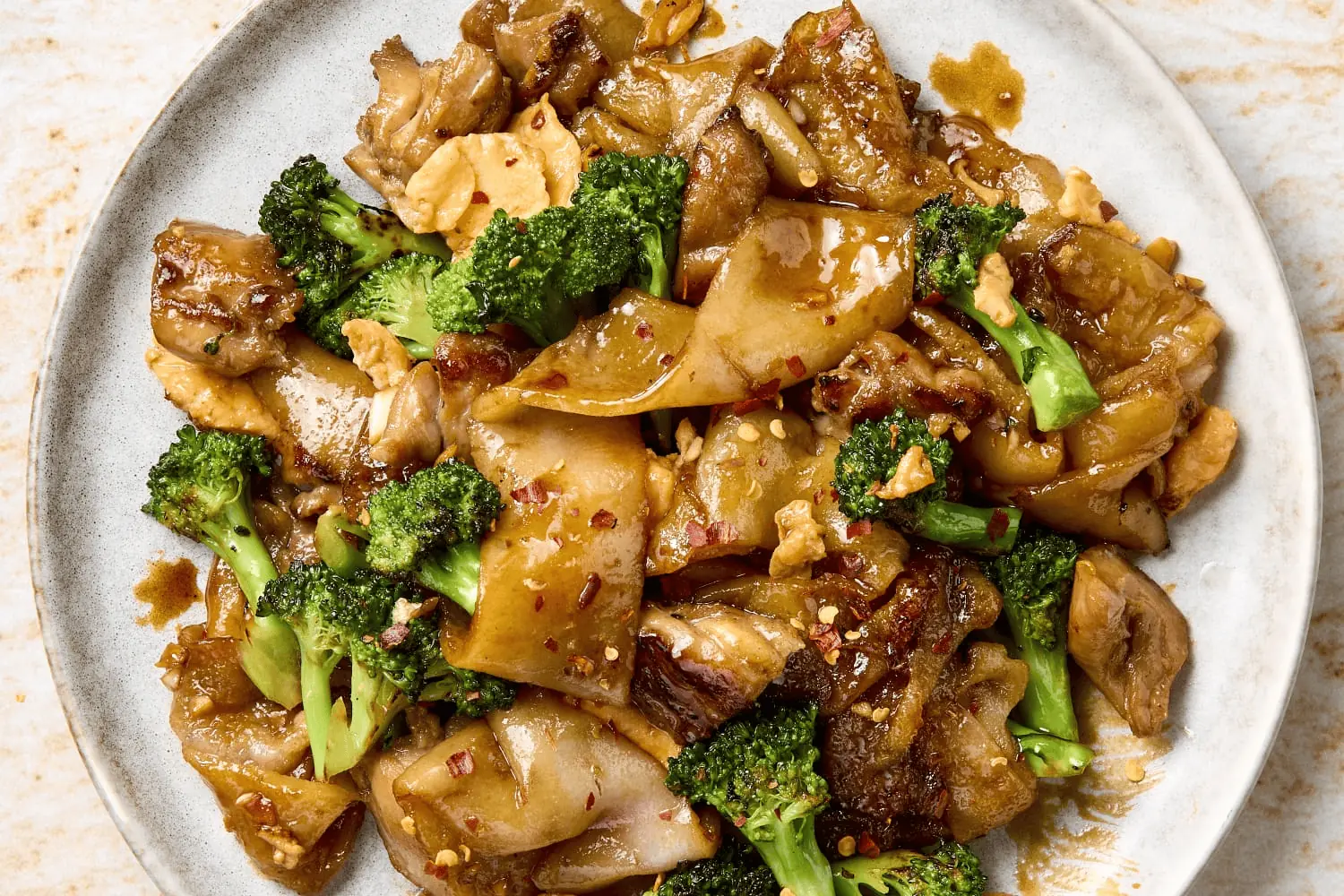
Wide rice noodles charred against hot metal, dark-soy-forward and barely sweet — cooked one plate at a time, the way the stall actually does it.
Noodles
Chicken and Marinade
Premixed Sauce (divided into 4 bowls)
Held Separately, Added Last
The Rest
Prik Nam Som (table condiment)
Overview
Pad see ew (ผัดซีอิ๊ว) is the only dish in the Thai canon named after a sauce — “stir-fried [in] soy sauce.” Savory first, lightly sweet second, and neither sour nor spicy. Its signature is char.
The shape of the cook, up front: the chicken and the greens are seared once, for everyone. The noodle stage is cooked four separate times, one 8 oz portion per plate, about 90 seconds each. That is the whole discipline of this dish, and it is free. It also means the plates go out in waves — a real cost with no technical workaround, and exactly what happens at the stall.
Read This Before You Shop
Two decisions are made before you turn on a burner, and neither can be fixed at the stove.
The bottle. You need two Thai soy sauces. Thai thin soy (ซีอิ๊วขาว) is your salt — Healthy Boy / Dek Som Boon is the standard. Thai black soy (ซีอิ๊วดำ) must be bought by the Thai label color, because the English names on export bottles are genuinely broken — the same product class ships as “Dark Sweet,” “Dark Thick,” “Black,” and “Stir Fry Seasoning Sauce.”
| Label color | Thai name | What it’s for |
|---|---|---|
| Yellow or orange | ซีอิ๊วดำ — plain black soy | This dish |
| Green | ซีอิ๊วดำหวาน — sweet black soy | Braising, glazing |
| Red | ซีอิ๊วหวาน — sweet soy | Table dipping condiment |
Do not substitute Chinese dark soy (老抽) one-for-one. Thai black soy runs roughly 0.80 g salt and 4.86 g sugar per tablespoon; a typical Chinese supreme dark runs about 3.41 g salt and 1.65 g sugar. Swap a tablespoon and you have silently added more than half a teaspoon of salt and removed most of the sweetness. The color comes out right and the plate tastes brutal. This is the single most common cause of home pad see ew that looks correct and isn’t. Thai black soy isn’t really a long-fermented dark soy at all — one UK label of this class declares molasses 70%, water 21.8%, salt 6.5%, soy sauce 1.7%. It’s a molasses syrup that contains soy sauce.
If you already own the wrong bottle: with Chinese 老抽, use noticeably less and add an extra teaspoon of brown or palm sugar per plate. With sweet black soy (green label) or kecap manis, use about half the volume and cut the sauce sugar to ½ tsp per plate. With Chinese light soy (生抽) in place of Thai thin soy, cut the volume about 15%.
The noodles. Fresh wide rice noodles, sen yai. Two grades exist — a soup grade high in tapioca and a stir-fry grade that is predominantly rice flour. Buy stir-fry grade if the shop distinguishes them; soup-grade noodles go mushy and weld to the pan no matter how well you cook.
Safety. Do not hold fresh rice noodles at room temperature overnight, under a damp cloth or otherwise — you will read this advice elsewhere. Wet rice-flour products held at ambient temperature are the classic vehicle for Bacillus cereus and for bongkrekic acid, which is heat-stable and has no antidote. Refrigerate them, then bring them back with heat.
Equipment: Look Up Your Burner’s BTU Rating First
Everything downstream depends on whether you have 9,000 or 25,000. Under ~15,000 BTU, or on electric or induction, use a 12-inch flat carbon steel skillet. At 15,000+ BTU on gas, either a flat-bottom wok or the skillet is fine.
Contact area is why. A 13.5-inch wok can have only a 5.5-inch flat cooking disc — about 24 in², and that disc is the entire hot zone. A 12-inch flat skillet gives you roughly 113 in², nearly five times as much, and contact area is what this dish is made of. (Honest note: the cookbook authorities recommend a flat-bottom wok, not a skillet. Both cost $25–45. If you’re buying anyway on a weak burner, the skillet is the better bet.)
Season it and re-oil after every wash — that polymerized surface is the precondition for leaving noodles sitting undisturbed long enough to color. Nonstick can’t run hot enough to char; bare stainless welds the noodles to itself. Open the windows and run the hood on high; ventilation isn’t a flavor step, it’s why people back off the heat halfway through, which is the actual cause of gray noodles. You do not need a blowtorch, a high-BTU indoor range, or a wok ring.
What’s In and What’s Out
- Oyster sauce is in, at 1 Tbsp per plate. Its real contribution is mechanical — viscosity and starch, which is what makes seasoning adhere to slick rice sheets instead of pooling underneath. Most home cooks blame the pan when the actual failure is sauce that never stuck. Dropping it moves you toward the sparser vendor plate, not toward a worse dish; try it without once you know the dish.
- White sugar, not palm sugar. Thai sources specify น้ำตาลทราย, plain granulated. The black soy is already a molasses-and-palm-sugar syrup, and palm sugar just competes with a stronger source of the same note.
- No vinegar in the pan. The acid belongs at the table, where it stays bright and you can adjust it bite to bite.
- No cornstarch slurry, no thickener of any kind. Pad see ew has none; rat na (ราดหน้า) is defined by one. Thicken this and you have made bad rat na.
- No Shaoxing wine, no sesame oil, no fish sauce. Shaoxing adds water to a dish whose whole problem is getting dry enough to char. Sesame makes it read as lo mein. The salt budget is already spent.
- MSG, honestly: optional, and already in your bottles — Thai thin soy commonly declares E621 around 0.15%. If you add it directly, use very little, after tasting.
Steps
Steps 1–6 happen off the heat. From Step 7 on the pan is screaming and you won’t have a free hand — so read those steps now, not at the stove. Each Why box is optional background; tap it open when you want the reasoning behind a move.
1. Make the Prik Nam Som — Do This First
Slice the chilies into thin rings and drop them into the vinegar with a pinch of salt. Rest 10 minutes. Leave it on the table in a small bowl with a spoon.
Why the acid lives on the table, not in the pan
Pad see ew’s cooked sauce has no acid — definitionally, and it’s one of the things that separates it from pad thai. This condiment is the entire acid axis of the meal, and it’s what stops a sweet-salty plate from reading cloying.
2. Slice & Marinate the Chicken
Freeze the chicken 15 minutes (firm meat is what lets you cut it thin). Slice against the grain at about ⅛ inch, knife at roughly 45° — a thigh fillet’s grain wanders across the piece rather than running one way down a steak, so read the fiber direction on each piece before you cut. Toss with the thin soy, sugar, and starch. Refrigerate 15–30 minutes, no longer.
Why thin & against the grain — and why thigh, not breast
Past 30 minutes of marinating you buy about 3% more moisture, which is undetectable. Thin, against the grain is unanimous across every source in every language and is the highest payoff-per-effort move in the protein. The starch is a separate mechanism — a surface gel that makes the dark sauce cling. Keep the dose low; excess starch drifts toward rat na and tastes pasty.
Boneless skinless thigh, not breast. Thompson’s own recipe is titled for chicken thigh, so this is a documented version of the dish rather than a concession. Pork collar or neck is the Thai default across the native sources and swaps in one-for-one here if you’d rather. Chicken breast is the American-restaurant default and the one to skip — thigh carries enough fat and connective tissue to stay tender across a much wider doneness window, and pork collar does the same job for the same reason, which is why no baking soda appears here. Breast has neither margin. If you’re stuck with breast or another lean cut, add ⅛ tsp baking soda per 8 oz of meat, unrinsed, and do not scale it up — this dish has no lime or tamarind to hide an alkaline note behind.
3. Prep the Gai Lan
Separate leaves from stems into two piles. If the stems are thick, slice them on the diagonal about ⅛ inch thick and 2 inches long, or split them lengthwise so nothing is wider than about ⅓ inch. If you can find young thin-stemmed gai lan tips, buy those instead and skip all of this.
Why leaves and stems go in separate piles
Stems need roughly 30 seconds and leaves roughly 15 — a 2× gap that cannot be reconciled inside a 90-second stir-fry. Either the knife fixes it or the shopping does. Keep real gai lan: its bitterness is a structural counterweight to a sweet-salty sauce. Broccolini is the good fallback; bok choy is too wet; carrot makes it actively worse by adding sweetness.
4. Revive the Noodles Until Piping Hot
Microwave the noodles in 1-minute bursts, gently separating the sheets by hand between each burst, until hot all the way through — roughly 3–4 minutes per pound. Not warm. Not merely pliable. Hot. Then divide into four piles of 8 oz each. Add no oil — fresh sen yai arrives factory-oiled.
Why hot, not just pliable — this decides ribbons vs. shards
Extra oil on fresh sen yai costs you sauce adhesion and char, so skip it. This decides ribbons versus shards, and it’s decided before the burner is lit. The starch crystallites that make a cold noodle brittle melt between 50 and 80 °C — stop at “flexible” and you’ve left a cold core of fracture points that will shatter under the spatula. The heat-then-separate loop is the technique; one long blast gives hot edges and a cold middle. Never peel them cold, and do not microwave and boil.
5. Premix the Sauce; Black Soy on Spoons
Stir the thin soy, oyster sauce, sugar (and MSG if using) together and divide into four small bowls. Put the black soy into four separate spoons, 1 tsp each.
Why premeasure every plate
The noodle stage runs 60–90 seconds and the noodles absorb all of it — there is no pan sauce left over to dilute a mis-pour. Nobody free-pours from bottles at this speed and gets the ratio right.
6. Set Your Station
Line everything up next to the stove in the order you’ll reach for it: four noodle piles, four sauce bowls, four spoons of black soy, marinated chicken, garlic, gai lan in two piles, four eggs, oil, white pepper mill, four warm plates.
Why this matters more than it sounds
From the moment the burner is on you have about three minutes per plate and no hand free to measure. The entire argument for premixing collapses if the bowls are still in a cupboard.
7. Sear the Chicken & Greens — Once, for All Four Plates
Preheat the dry pan on your highest heat until visibly smoking, 2–3 minutes (it will feel like too long). Swirl in about 2 Tbsp oil to coat the whole surface, then pour the excess back out, leaving a film.
Garlic in, 15 seconds, until fragrant but not colored. Add all the chicken, spread it in one layer, and let it take contact — 60–75 seconds, until roughly three-quarters done: outsides opaque and browned in patches, thickest edges still faintly translucent. Scrape into a bowl with all its juices — it finishes in Step 12.
Fresh oil if the pan looks dry, then the gai lan stems, ~30 seconds, until glossy and bright green with the cut edges just starting to blister. Leaves, ~15 seconds, until barely wilted. Into a second bowl. Divide both into four portions.
Why sear everything first, and why pull the chicken early
On a home burner all your energy has to be banked before food goes in, because you’ll never recover it once it does. This is the most common home failure and it costs nothing but two minutes that feel excessive. The swirl-and-pour-off lays a sacrificial film that keeps rice starch off bare steel — it’s anti-stick, not flavor, and it fixes greasiness at the same time: full coverage without full volume.
The two-stage cook is the only way char forms at all on a domestic burner. Water from the egg and the chicken keeps the noodles from ever charring, and once wet ingredients are in the pan a home burner never gets back to a char-forming state. Pulling the chicken at 75% is a moisture step, not a doneness step; it finishes in the last 30 seconds of each plate — see Step 12 for the doneness check that matters.
8. Wipe the Pan — This Is the Gate
Wipe it out with a paper towel held in tongs. It should be visibly dry before you go on.
Why the pan has to be bone-dry
If there is standing liquid in the pan, the noodles will steam instead of char.
9. One Plate at a Time — Reheat Dry, Then Oil
You now cook four plates, one at a time. Steps 9–12 are a single plate — about 90 seconds on the heat. Plate it in Step 13, then come straight back here for the next. Repeat four times — plates 1 · 2 · 3 · 4.
Pan back over the highest heat until it smokes again. Every round starts from a smoking pan. Add ~1 Tbsp fresh oil, swirl, pour off the excess.
10. The Egg
Reheat the empty pan about 10 seconds, add a splash of fresh oil, and crack in one egg. It should spit and sizzle audibly the instant it lands — if it doesn’t, lift the egg out and reheat the pan. Let it sit undisturbed (5 seconds for softer curds, up to 30 for large, browned, distinctly charred ones), then break it up with the spatula.
Why the egg goes in first, and alone
The instant sizzle is your free diagnostic, taken at the exact moment it still matters — nothing later in the plate recovers a cold start. And an egg cracked onto moving, sauced noodles never sets into curds; it hydrates the noodle surfaces and vanishes as a slick film. Cooked first on the bare, empty pan, its whole surface is your hot zone.
11. Noodles & Sauce
Add one 8 oz pile of hot noodles and one bowl of premixed sauce. Fold two or three times to distribute — lift from underneath, sliding the spatula under the sheets, never dragging its edge through them. Then spread flat across the entire pan and leave it alone 15–30 seconds. Flip, spread flat, leave it again. Once more if the pan is still holding heat. Go by smell, not sight — you can’t see the bottom layer; flip the moment you catch something starting to get a little too browned. Total: 1 to 1½ minutes, not more.
Why you spread it flat and leave it alone (and cook one plate)
Char is a surface conduction event, and every toss resets the contact. The static rest is honest home-burner compensation, not received Thai practice — a 150,000-BTU jet burner recovers instantly and chars noodles in motion; a 12,000-BTU range does not. It only works if you preheated dry and you’re cooking one portion.
The batch limit is the single highest-payoff instruction in the dish, it is free, and it requires no skill. Piled noodles trap steam and insulate themselves from the metal. The noodles arrived fully cooked and fully hydrated, so added moisture is pure downside, and evaporation is limited by surface area — a deep pile vents nothing. Operational form: food should never fill more than a third of the pan’s volume.
12. Chicken & Greens Back, Then the Black Soy Last
Return one portion of chicken and one portion of gai lan, fold through ~30 seconds. The chicken finishes here — it should be opaque all the way through, with no translucency at the thickest edges; if any is left, give it another 15 seconds before the plate leaves the pan. Then drizzle 1 tsp of black soy over the spread-out noodles — distributed across the surface, not pooled in one spot and not down the sides of the pan. Fold once or twice and give it a few more seconds on the heat.
Why the chicken finishes now, and the black soy goes in last
Poultry gets no 145 °F allowance the way whole-muscle pork does. At ⅛ inch, folded through a smoking pan for 30 seconds, doneness happens on its own — so look, don’t reflexively add time. The last plate is the one to watch: that chicken has been sitting in a bowl for ten minutes and goes into the pan cool.
Adding the black soy last is a zero-cost change to the order of two pours. The extra sugar in black soy clings to the noodle surface and exaggerates the caramelizing and charring right when the pan is hottest; all three major cookbook authorities season late. Distribute rather than pool — black soy is a sugar syrup, and a puddle over-reduces into a bitter blotch while the noodles beside it stay pale. On a home burner the flame never reaches the pan’s rim, so pouring down the sides just runs cold sauce into the middle anyway.
13. Plate Now — Then Cook the Next Plate
Onto a warm plate. Grind white pepper over the top. Serve — now.
More plates to go? Wipe the pan and go straight back to Step 9 (reheat dry to smoking, fresh oil). By the third plate you’ll be doing it without reading.
Why white pepper, and why you can't hold the plate
The seared taste only lasts a minute or two — holding plates in a low oven undoes everything you just did. Don’t skip the white pepper, freshly ground; pre-ground goes musty. It’s universal in Thai-authored recipes and nearly absent from Western home versions, and its absence is a real part of why a home plate reads as just “brown noodles.”
Notes
- What you’re aiming for: noodles that look a shade too dark, with visible blistered patches. Savory first, lightly sweet second — not sour, not spicy. Distinct browned egg curds rather than a yellow film. Gai lan stems with a snap still in them. Sauce that clings, with essentially no liquid pooled in the bottom of the plate.
- How to read a miss: wet and gray, no color — the pan wasn’t hot enough, or there were too many noodles in it, and both are free to fix. Harsh and aggressively salty — you have Chinese 老抽 in the bottle, not Thai black soy. Cloying — the black soy was a sweet grade, or the prik nam som never made it to the table. Gluey — the noodles cooked far too long and shed their starch, or someone added a slurry.
- Wok hei, honestly: you cannot get it. A commercial wok range runs 150,000 BTU against a home stove’s ~12,000. What is fully available at home is contact char — dark-soy sugars and noodle starch browning against metal at 200–400 °C, which an empty home pan reaches easily. Only the aerosolized-oil smoke note is out of reach, and it’s also the least-evidenced of the four mechanisms.
- Breakage is normal. Restaurant pad see ew is not long strands. Cooks chasing zero breakage under-agitate and lose the char, which is a much worse trade.
- Optional pre-toast (คั่วเส้น) — only if your burner is under ~15,000 BTU. After preheating and oiling in Step 9, toast the plain noodles alone in the pan until browned and fragrant, 45–60 seconds, lift them to a plate, cook the egg, then return them. The verb is คั่ว, dry-roast, not ผัด, stir-fry. Cooks who use it cut their black soy sharply, because the color already came from the toast. It is a rival to the static rest, not a complement — pick one. Claim the crust, not the smoke.
- If you can only get dried noodles: use 500 g dried wide rice noodles for four plates. Soak in hot, off-the-boil water for 15 minutes, drain, rinse cold, and pull them pliable but not fully soft — they finish cooking in the pan. Then, and only for dried, toss with about 1 Tbsp of oil, since rehydrated dried noodles arrive naked and sticky where fresh sen yai comes factory-oiled. The texture is genuinely different, not merely lesser, but it still makes a good plate.
- The three things worth spending money on: a $25–45 flat-bottomed carbon steel wok or 12-inch carbon steel skillet, a $15 metal wok spatula with a thin leading edge, and the right bottle of Thai black soy sauce. Everything else that improves this dish is free.